Sunday, September 21, 2014

The Night Circus by Erin Morgenstern

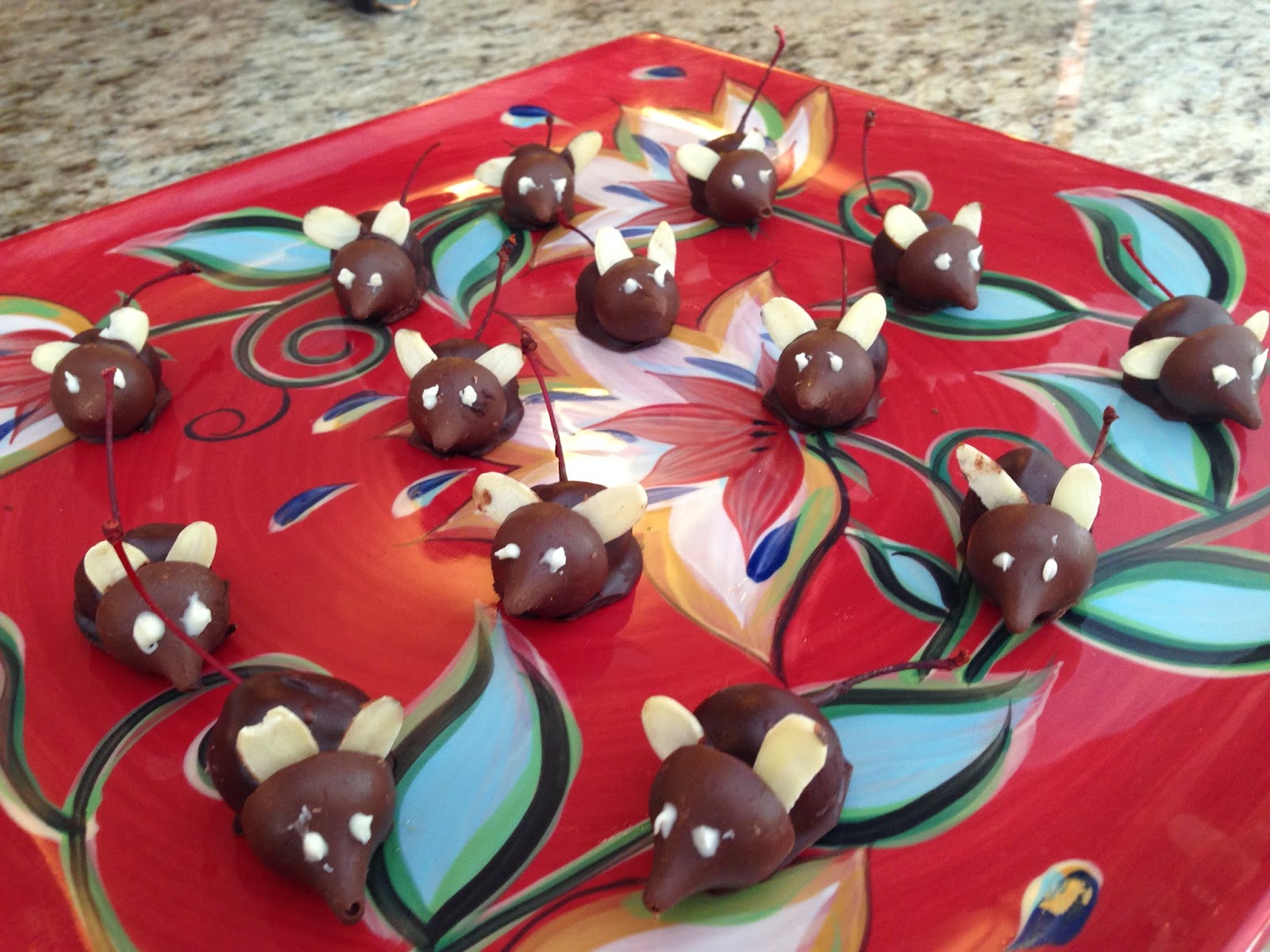
After a long summer hiatus, it was good to once again have everyone in attendance so we could catch up on one another's busy, yet fun summer.  We gathered back together at JoAnn's home on a warm September Saturday.  Since our novel was about a magical circus, JoAnn laid out a proper circus diet of hotdogs, corndogs, pickles, and the cutest chocolate mice.
Synopsis:
Marco and Celia are pawns in a challenge set by their mentors when they are but still children.  Unbeknownst to them, this duel of magic will require one of them to die in order for there to be a victor.  In the mystical setting of the night circus, these two opponents fall in love and begin a love affair expressed through beautiful magical creations.  Unfortunately, the challenge cannot be undone and the circus and all its performers are at risk as the couple's passion grows.

Comments:
First of all, it must be stated that we all agreed that the author has a wonderfully, creative imagination and the ability to create such fantastical magic with her ink and paper.  Her descriptions of some of the tent rooms had a dreamlike effect. That being said, it was also true that this imaginative circus was at times too fantastical and a bit much on the stretching of our imagination.  The clockmaker, Herr Thiessen, is one such example.  The descriptions of his clock creations were beyond comprehension.

The elaborate dinner party feasts which Chandresh hosted at midnight in his home were deliciously described.  We found it interesting to note that one of the characters, Isobel the fortune teller, may have been considered a minor character and bit player in the circus, but we discover near the end of the story that all along her simplistic little charms had a major effect on the success of the picture perfect night circus.

The character development was weak, while imagery descriptions were too lengthy and detailed at times.  The non-linear timeline was difficult to follow.  However, this was a sweet love story and we enjoyed visualizing the tent room creations which were the couple's love letters to one another.

Memorable Quotes:
"Better to have one single diamond than a sack full of flawed stones."
Oscar Wilde - "A dreamer is one who can only find his way by moonlight, and his punishment is that he sees the dawn before the rest of the world."

FAB Rating: ***1/2 (3-1/2 stars out of 5)
We unanimously categorized this book as more of a beach read, maybe even more fitting in the young adult genre.  With all the great visual descriptions, it will make for a fun movie to view.

Tuesday, June 24, 2014

The Orphan Master's Son by Adam Johnson

On Thursday, June 12, four of us met up at Cru Food and Wine Bar at the Domain in Austin for a delicious lunch.  We had a private dining area reserved just for us, although for the majority of the two hours we were there, we had the entire restaurant to ourselves.
After much discusion regarding each of our various summer plans, we all were in agreement that this would be a good time to take a hiatus with the intent to return to our meeting together in September.

Synopsis:
This book is divided into two parts.  In the first half of the story, Jun Do is introduced and we learn that he is raised in a state orphanage in North Korea.  He serves the state as a loyal citizen which includes him performing horrific acts including kidnappings.  As part of a diplomatic delegation, he travels to America.  His mission is viewed as a failure and results in his imprisonment.  During the second half of the book, Jun Do assumes the identity of Commander Ga which includes being the husband to the actress Sun Moon.  Commander Ga will be chosen by the Dear Leader to work with the Americans and it is through that assignment that Jun Do/Commander Ga puts a plan into action.

Comments:
Everyone agreed that this was a great story and was was well-written by a great storyteller.  However, the majority of us found the story to be too depressing.  It certainly could not in our terms be called a pleasant read.  We agreed with the author's own categorical designation of his novel: a trauma narrative.  This story highlights the appalling conditions in North Korea.  The inhumanity of mankind was shown to have no limits.  It is difficult to read about the oppression and manipulation of an entire population of Korean citizens.

Jun Do is representative of the comman man in Korea -- the Korean version of John Doe -- and the struggles to survive in this politically and culturally repressed society.

There were a few comedic moments woven into this novel.  The one which our group laughed about was the shock and disgust in which the delegates relayed their experiences with the Americans, particularly their trip to Texas and how we treat our canine pets. 

Memorable Quote:
Dr. Song--"Where we are from," he said, "stories are factual.  If a farmer is declared a music virtuoso by the state, everyone had better start calling him maestro.  And secretly, he'd be wise to start practicing the piano.  For us, the story is more important than the person.  If a man and his story are in the conflict, it is the man who must change." (p. 121 - Kindle)

"A name isn't a person," Ga said. "Don't ever remember someone by their name.  To keep someone alive, you put them inside you, you put their face on your heart.  Then, no matter where you are, they're always with you because they're a part of you." (p. 379 - Kindle)

FAB Rating: **** (4 out of 5 stars)
Although very difficult to read at times, the writing was excellent and the story compelling.

Saturday, April 19, 2014

The Immortal Life of Henrietta Lacks by Rebecca Skloot

On a Wednesday morning we joined together at Ellen's home for our April book club meeting.  We filled our bellies with spaghetti, salad, and sweet rice pudding.  Ellen had put together the most creative book-themed favors and set them beside each of our plates: candy filled petri dishes.


Summary:
Henrietta Lacks is a poor black woman who goes to John Hopkins Hospital in 1951 for treatment of cervical cancer.  Before she dies, a surgeon takes samples of her tumor.  Those cells became the first immortal human cells ever grown in a lab.  These cells known as HeLa cells, were sold around the world to other scientists, researchers, and doctors, and were one of the most important things that happened to medicine in the last one hundred years.  Her cells went on to become part of groundbreaking research into such studies as leukemia, cancer, herpes, influenza, polio, hemophilia, Parkinson's Disease and more.  This true story sounds wonderful until you realize that an injustice was done to Henrietta and her family.  Henrietta did not give consent for her cells to be taken and used by the doctors, and until many years later none of her family was aware of the action taken much less the significance and fame which came about from the use of those cells.

Comments:
In portions of this book we experienced kindred feelings with the subjects as they expressed anger and frustration at the inequities and injustices dealt to them because of their social and economic class.  It was especially infuriating and heartbreaking for us to learn of the mistreatment of Henrietta's mentally challenged daughter and the many other patients who were institutionalized at that time.  There were a few bright spots in this story.  One man in particular, researcher Christoph Lengauer, treated Deborah and her family with respect and compassion.

Author Rebecca Skloot spent years researching this fascinating story and familiarizing herself with Henrietta's family.  She displayed the patience of Job where it concerned developing a relationship with Henrietta's daughter and her other family members.  That long quest equated to a long book.  Thoroughly researched and thoroughly reported!  The author's quest was well-rewarded as she not only shared with the world a compelling story, but she became accepted and loved among Henrietta's family.  The following scene sums up well the connection and impact Rebecca had on the Lacks family:  One Sunday Deborah's congregation sang, "Stand by me, while I run this race, for I don't want to run this race in vain." Her preacher husband, Pullum, pointed at Rebecca and yelled, "Come stand by me!"  Rebecca had truly stood by the Lacks family and ran the race with them to see their mother recognized for what she had unknowingly contributed.  Pullum later pointed to Deborah's granddaughter, sitting in her grandmother's lap in the pew, and yelled, "This child will someday know that her great-grandmother Henrietta helped the world!"  He then pointed around the room at other cousins saying, "So will that child...and that child...and that child.  This is their story now.  They need to take hold of it and let it teach them they can change the world too."

Memorable Quote:
"...if you gonna go into history, you can't do it with a hate attitude.  You got to remember, times was different." said by Deborah, Henrietta's daughter. (p. 276 - Kindle)

FAB Rating: **** (4 out of 5 stars)
This story sparked curiosity in us as we learned more about HeLa cells and the impact they have had on our world.  Most amazing is that those cells are still being used today! We admire the tenacity with which Ms. Skloot tackled this project.  It was well worth her efforts.

Sunday, March 9, 2014

Orphan Train: A Novel by Christina Baker Kline

On Saturday, March 1, we converged on Marcia's fine home in Smithville for our monthly meeting. Our gracious host served us a filling brunch of egg casserole, fresh fruit and sweet Irish oatmeal. In the company of good friends, both the conversation and time quickly flew!

Summary:
Molly is a current day foster child struggling to survive the tumultous journeys from one foster home and town to the next one.  Vivian is an elderly lady living alone with only her memories to keep her company in a giant old home across town.  These two women forge an unlikely friendship which will bring answers and ultimately the healing they both desire.

Comments:
The orphan train transported a reported 200,000 children from the East Coast to the Midwest between 1854 and 1929.  This part of our American history was unknown to a few of our readers. The reality of this heartbreaking time provided for an interesting storyline. The author wove into the storyline the lesson of portaging, especially in relation to the Wabanakis Indians, a part of Molly's heritage.  The act of traveling light and leaving some things behind was well understood by the orphans, Vivian and Molly. "Nothing encumbered movement more than fear, which was often the most difficult burden to surrender." (p. 5 - Kindle)

Vivian was one of those orphans transported from New York City to Minnesota.  Her story was not a happy one, but she managed to rise above the tragedies of her youth.  Despite her outward successes in her life, even in her nineties Vivian was still haunted by those loved ones whom she had lost.

Molly was the modern day version of Vivian - an orphan shuttled from home to home who loved to read and buried her pain in order to survive in the harsh reality of her world. The tough exterior marked by Goth makeup hid the vulnerable and hurting child inside her.  Molly was fascinated by Vivian's story and felt a connection to her which inspired her to seek the truth in both Vivian's and her own life.  "You can't find peace until you find all the pieces.  She wants to help Vivian find some kind of peace, elusive and fleeting as it may be." (p. 177 - Kindle)

Brenda noted a disturbing trend in this novel: the majority of the female minor characters were portrayed as mean-spirited and vindictive.  Conversely, their male counterparts were portrayed as weak, passive men who merely helplessly shrugged as they witnessed first-hand the cruel words and actions those women displayed towards Vivian and Molly.

When we completed our discussion time together we all readily accepted Marcia's invitation to tour the old Burleson Mansion there in town where her husband was working (thanks again, Marcia!!)  In a twist of fate, a lady who was there at the time perusing some of the antiques and collectables to purchase, heard what book we had just finished discussing, and she shared with us the story of her own father and his siblings who had been orphan riders on the train.  Fascinating story which added another rich layer of truth to this period of time in America.  And as a side note, if you have a little bit of cash stashed under your mattress, you might want to consider purchasing this beautiful home since it's on the market!


Memorable Quotes:
"...the people who matter in our lives stay with us, haunting our most ordinary moments. They're with us in the grocery store, as we turn a corner, chat with a friend. They rise up through the pavement; we absorb them through our soles." (p. 176 - Kindle)

"Time constricts and flattens, you know. It's not evenly weighted. Certain moments linger in the mind and others disappear." (p. 176 - Kindle)

FAB Rating: **** (4 out of 5 stars)
Although the story was a bit predictable, overall it still provided a compelling read.  Some of us had trouble connecting with the two main characters, although we agreed that Molly's character was true to life for a lot of young women.


Friday, February 7, 2014

Destiny of the Republic: A Tale of Madness, Medicine and the Murder of a President by Candice Millard

On Wednesday, January 29, our entire group converged upon Diana’s home for an early February book discussion.  With an abundant Meyer lemons crop this year, Diana prepared some lemony delicious dishes including a dessert that was the perfect marriage of a lemon bar and a pie – yum!

Summary:
This non-fiction book was written to expose the modern day reader to the behind-the-scenes events in the late 1870’s and early 1880’s which ultimately led to the death of President James Garfield.  Through extensive research, Ms. Millard constructs a fascinating historical record of the election and assassination of a president who only spent a few months in office.

Comments:
This story had all the ingredients of a best-selling fictional novel -- a world famous inventor, a madman, political villains, medical science breakthroughs, and a kindhearted man whose life was cut short by a lunatic’s bullet and inept doctors – except this is a true story!  

It was interesting to see how our political system has evolved from its early beginnings. The overt corruption and strong-arm tactics were disappointing, while the drama of the conventions was thrilling. It’s a shame that the practice of granting the citizens access to the president, which made perfect sense to a nation which had not that long ago broken free of the monarch’s rule, is one of the reasons that we lost a few of our U.S. presidents to assassinations. 

Our resident medical expert was most disturbed by the ego of the book's medical professionals which kept them from ever considering options which may have saved President Garfield, including Alexander Bell’s liberal use of his metal detector to locate the bullet and sterilization of medical tools. Joseph Lister had unsuccessfully tried to convince American doctors to sterilize everything when dealing with open wounds. Although an accepted practice at that time among European doctors and medical facilities, their American counterparts were slow to believe in the importance of antisepsis – preventing infection by destroying germs - a concept which has saved millions of lives.  More than twenty years after Garfield’s death, the American ambassador to England shared these words at the Royal Society:  “My lord,” the ambassador said, addressing Lister as he sat in an opulent hall, surrounded by powerful men and celebrated scientists, “it is not a profession, it is not a nation, it is humanity itself which, with uncovered head, salutes you.” (p. 259 – Kindle)

What a tragedy to lose a president who believed in equality for the newly freed slaves and who had a desire to work with men from both political parties.  He could have made much needed positive changes for a nation which was still deeply wounded from a destructive civil war.  President Garfield was a loving husband, father, and loyal friend who even on his death bed as he suffered through intense pain evoked this heartfelt tribute:  “Even as he lay dying, Garfield was kind, patient, cheerful, and deeply grateful.” (p. 227 – Kindle)

Memorable Quote:
We loved President Garfield’s quotes which were placed at the beginning of each of the new chapters.  Here are a couple of our favorites:

“Theologians in all ages have looked out admiringly upon the material universe and…demonstrated the power, wisdom, and goodness of God; but we know of no one who has demonstrated the same attributes from the history of the human race.” (p. 48 – Kindle)

“I love to believe that no heroic sacrifice is ever lost, that the characters of men are moulded and inspired by what their fathers have done.” (p. 173 – Kindle)

FAB Rating: ***** (5 out of 5 stars)
What an interesting time for our nation.  We all learned so much from this book. This story is well written, thoroughly documented and presented in a way which made this reader want to keep reading in the hopes that the president would eventually survive, even though I knew the ending!  If Ms. Millard had been my high school American History teacher, I am pretty sure I would not have daydreamed as much as I did in that class!

Monday, January 13, 2014

You Are One of Them by Elliott Holt

Our January bookclub meeting was held at Olde World Bakery & Cafe in downtown Smithville.  We met for brunch and we all ordered a variety of items including strawberry crepes, migas, egg sandwich, and breakfast burrito.  Once our plates were licked clean and we had finished catching up on our personal lives, local news and gossip, we dove right into the world of the USSR.
Olde World Bakery - Smithville, Texas

Synopsis:
Sarah Zuckerman had a few bright and shining moments in her growing up years and the majority of them appeared to center around her friendship with Jenny Jones.  However, Jenny’s life is cut short in an accident which just adds to Sarah’s list of losses in her life.  Jenny’s influence is felt even into adulthood for Sarah and so after graduating college she travels to Russia to begin a quest which may not answer the question Sarah initially sought to resolve, but will eventually set her free.

Comments:
This fictional book was loosely based on true events which occurred from 1983 through the late 1990’s.  We found it to be similar to how the television show “Law and Order” creates their storylines.  In addition to that, the author had once lived in Russia while working as a copy editor, similar to the book’s main character.  We learned what Russia was really like during this time period as the country struggled to adapt to the marketplace demands of a Western world while chained to the economy and education of the old federation.  

As we progressed in this novel, we came to understand that the title “You Are One of Them” does not actually relate to Jenny Jones as the reader may first believe.  Sarah had continued to view herself through the lens of childhood.  She could not see that she had grown out of the awkward stage, the misfit label, and the cloak of tragedy which had shrouded her growing up years.  Young Sarah finds that those whom she dearly loves will soon leave her.  These lost loves she refers to as defectors came about through death, as with her sister and Jenny, and through divorce, as with her father.  Sarah even refers to her home as “a museum, filled with relics” which looks back and not forward.  She cannot shed the skin of her past in order to confidently live and appreciate her adult life…at least not until her fateful journey to Russia.  There in the bleakness of a Russian winter -- “There is something painfully honest about winter: the skeletal trees, the brutal repetition of the cold.  There are no empty promises, no hazy, humid hopes.  It’s reality, lonely and stark.”-- Sarah will finally be able to free herself from the past and move forward.

Memorable Quote:
“People believe in things until they don’t need to anymore.” (p. 283 – Kindle)

“If regret had an odor, it would smell like an ashtray.” (p. 255 – Kindle)

“And I have come to believe that forgiveness is the key to survival.  It does no good to see everything as a struggle between opposing factions.  Few things are that simple.” (p. 102 – Kindle)

FAB Rating: ***1/2 (3-1/2 out of 5 stars)

There was not much meat to chew on with this book.  We likened it to a good beach/travel book which you would purchase to pass the time while relaxing, never spending time contemplating its merits. 

Monday, December 23, 2013

A Constellation of Vital Phenomena: A Novel by Anthony Marra

On Saturday, November 23, we met at Jonetta's new home in Austin to discuss our latest novel.  As usual when Jonetta hosts book club during the fall/winter season there was a major cold front which came through complete with rain/sleet mixture!  Thank you to the three brave souls who traveled the long distance for some warm food and scintillating conversation.  Our authentic Russian meal was prepared by The Russian House in downtown Austin.  We dined on Tarragon Salad, Russian Blinis, and Ukrainian Borsch served with Cheburek.  The roasted tiger figs topped with honey goat cheese, homemade by our hostess, provided a sweet ending to our meal.

Synopsis:
Akhmed risks his own life to save the young daughter of his friend and neighbor who has been taken by the Interior Ministry, a fate of death.  In his attempt to keep Haava away from those who would have also killed her, Akhmed takes her to the hospital where he involves the only doctor there, Sonja.  Over the period of a few short days the characters will discover they are connected in ways which will bring both desired answers and heartbreak.

Comments:
What is amazing to all of us is that this is a modern story based on true events and yet our ignorance to the suffering of the citizens and destruction of the landscape of Chechnya was evident as we read this novel.  The horrors which these people have endured throughout the years as a direct result of the Chechen Wars is eye-opening.  However, the author shows the resiliency, courage, and compassion which humans can choose to display despite their circumstances.  He was also fair enough to highlight those characters who choose an alternative path in their life, whether out of greed or self-preservation.

As the story revealed itself, the characters evolved.  Natasha provided the biggest surprise for us, while Ramzan revealed a motivation which explained his character flaw and perceived wickedness.  Akhmed's artistic ability and endeavors were beautiful as he attempted to memorialize those folks who had lost their life in the cruelty of the war.  His art was a documentary of lives and the city as it was or should have been.

The author's use of descriptive phrases painted such vivid pictures for the reader.  The following are a few of our favorites: "The soldiers were all fear and peach fuzz." (p. 28 - Kindle); "For months they'd run their fingers around the hem of their affection without once acknowledging the fabric." (p. 286 - Kindle); "...that utopian mirage cooked up by cruel young men who gave their mustaches more care than their morality..." (p. 80 - Kindle); "And after the fire had read his pages, and the dogs basked in the warmth, and the ashes grayed the snow..." (p. 96 - Kindle)

Memorable Quote:
"She marked the days, but time didn't march forward; instead it turned from day to night, from hospital to flat, from cries to silence, from claustrophobia to loneliness and back again, like a coin flipping from side to side. Happiness came in moments of unpredictable loveliness." (p. 34 - Kindle)

"There is something miraculous in the way the years wash away your evidence, first you, then your friends and family, then the descendants who remember your face, until you aren't even a memory, you're only carbon, no greater than your atoms, and time will divide them as well." (p. 124 - Kindle)

FAB Rating: **** (4 out of 5 stars)
Although the setting of this novel proved to be dark and unsettling at times, the main characters compelled the reader to keep reading as they revealed their vulnerabilities, strengths, flaws, and secret desires. As one FAB member so poetically stated, "The threads of the story woven throughout finally produce the tapestry of the story at the end." The end proved worth the read and the revealed truths made for a fascinating story which stays with the reader long after the book has been closed.


Friday, November 8, 2013

The Unlikely Pilgrimage of Harold Fry: A Novel by Rachel Joyce

JoAnn was our host on a beautiful Sunday afternoon in October.  With a nod to the mushrooms and other field greens our protagonist ate along his journey, JoAnn created a delicious salad which alone would have been filling.  However, our gracious hostess also treated us to some of her delicious homemade soup - yum!  Of course, there was also the obligatory dessert which everyone willingly devoured.

Synopsis:
Retiree Harold Fry receives a letter out of the blue from a previous co-worker with whom he has not had contact for many years.  This letter will be the catalyst for a journey which will take Harold out of his comfort zone both physically and emotionally.  What begins as a quest to save a dear friend's life will in the end actually serve as the salvation for Harold and his wife, Maureen.

Comments:
This aptly named novel began with a fitting quote from The Pilgrim's Progress by John Bunyan:
Who would true valour see, 
Let him come hither; 
One here will constant be 
Come wind, come weather.  
There's no discouragement 
Shall make him once relent 
His first avowed intent 
To be a pilgrim.

Harold showed courage and determination in his own pilgrimage no matter the weather and the discouraging remarks of others.  His valiant effort to save Queenie resulted in him avowing to walk all the way to Berwick-upon-Tweed where she was in hospice care.  Harold was in a spiritual crisis and true to the nature of most pilgrimages, his walk became transformative and healing as he wrestled with atoning for the mistakes he had made in his life.  The use of his yacht shoes reminded the reader that this began as an unintentional journey when he first set out from his home only to mail a letter.  Along the way, the refusal to replace the yacht shoes with more sensible walking shoes became a self-imposed suffering to atone for his sins as Harold endured the blisters and painful infection in his leg.  Harold's long journey gave him time to recall memories which had long been buried in an effort to protect himself from the pain of those incidents.  However, it also gave him the opportunity to recall the good times which had been suppressed along with the bad times.

Harold met many interesting folks during his walk and with each of those characters he learned something more about human nature and in the process gleaned another nugget of truth about himself.  "He understood that in walking to atone for the mistakes he had made, it was also his journey to accept the strangeness of others.  As a passerby, he was in a place where everything, not only the land, was open.  People would feel free to talk, and he was free to listen.  To carry a little of them as he went." (p. 90 - Nook)  We were also reminded of the power of human connections, no matter how short the time spent together.  "They believed in him.  They had looked at him in his yachting shoes, and listened to what he said, and they had made a decision in their hearts and minds to ignore the evidence and to imagine something bigger and something infinitely more beautiful than the obvious." (p. 37 - Nook)

Memorable Quote:
"He had learned that it was the smallness of people that filled him with wonder and tenderness, and the loneliness of that too.  The world was made up of people putting one foot in front of the other; and a life might appear ordinary simply because the person living it had been doing so for a long time.  Harold could no longer pass a stranger without acknowledging the truth that everyone was the same, and also unique; and that this was the dilemma of being human." (p. 158 - Nook)

FAB Rating: ****1/2 (4-1/2 out of 5 stars)
The author did a wonderful job of doling out bits of relevant information along the journey so that the reader discovered the truth as Harold's repressed memories came back to him with each step.  This created unexpected twists to the story and kept the reader emotionally engaged.  This novel had many interesting characters who were true to the diversity of human nature.  Harold and Maureen were relatable and we were pleased that the ending of this story was sweet for them.  The unrealistic part of this story was where the author expected the reader to believe that an out-of-shape sixty-five year old man could manage to walk 627 miles on foot along major roadways in 87 days while stopping for visits, shopping, meals, and time off to rest and heal -- entirely in yachting shoes, no less!

Saturday, October 19, 2013

The Silver Star: A Novel by Jeannette Walls

Ellen was our hostess for the month of September as we met for the first time on a Saturday morning.  Although she had originally planned for us to eat outdoors, the weather was still just a bit nippy at that time of day. We enjoyed a delicious brunch indoors at her kitchen table and marveled at the size and color of the emu egg which Ellen had cleverly used as the table's centerpiece.


Synopsis:
Liz and Bean (Jean) are sisters who rely on one another to survive and thrive in a world where they have no father and their mother shirks her maternal responsibilities in order to selfishly pursue her own unrealistic dreams. In order to avoid the risk of being put in foster care, the girls escape to Virginia to live with their estranged Uncle Tinsely.  Living in the small town of Byler will bring challenges, learning opportunities, answers to familial questions, and a painful incident which will test the mettle of not only the girls but those who love them.

Comments:
This novel was Ms. Walls' first publicly printed foray into the world of fiction writing.  Having read her two best selling non-fiction novels, we immediately picked up on the strong similarities of this storyline and characters with the author's own true life experiences.  In particular, the sisters' mother was a believable character having known how Ms. Walls' own parents were portrayed in her autobiography.  Maddox's character was a bit unbelievable - just too ruthless, evil, and above the law while maintaining a position of authority in the factory.

Bean's character blossomed in their new town as she found her father's family loving and accepting of her. They filled in the gaps for her in her life story.  The awful incident which brought out the fighting spirit in Bean appeared to highlight the true fragility of Liz.  Bean had always heavily relied on Liz to direct her, but during their time in Byler, Bean became the leader and her strength and wisdom was beyond that of a typical twelve year old.

Liz found her sanity restored when she was given responsibility of two emus.  She was able to care for creatures who were as scared as she was at that time and who needed patient, loving care in order to trust humans - just like Liz.  The spoonerisms which Liz created were fascinating and entertaining.  On page 203 (Nook) she begins a long list of spoonerisms.  "Pack of lies.  Lack of pies.  Plaque of eyes, arranged by size.  Or black-eyed lies?"..."Plucked-out eyes.  Lucked-out lies.  Synthesize.  Between my thighs."..."To no surprise, to our demise."..."All the liars told their lies."..."Who denies the lies?  Who will scrutinize the lies? The size of lies? Who will pluck the liars' eyes? Who cries, who spies, who sighs, who dies?"  We were all amazed at the author's ability to creatively use words in that manner.  As fun as they were to read silently, it was even more fun to read them aloud!

Memorable Quote:
Interestingly enough, for someone whose presence was minimal in the storyline, the girls' mom had the most interesting and though provoking quotes.  Perhaps it is indicative of how much her words meant to her daughters who were deprived of typical maternal care and guidance.
"Don't be afraid of your dark places," Mom told her.  "If you can shine a light on them, you'll find treasure there." (p. 186 Nook)
"Find the magic," Mom always said.  "And if you can't find the magic," she added, "then make the magic." (p. 11 Nook)

FAB Rating: ***1/2 (3-1/2 out of 5 stars)
The story did start out in a way which captured our attention, but lost momentum and appeared to wind down instead of up.  It became predictable and then somewhat unbelievable when Maddox entered the picture.  The most unbelievable part was where the author had Bean's grandfather kill Maddox and the police not question the lame story he gave as his alibi.  Despite those negative traits, this story had enough meat to keep our attention and made for an easy read.


Wednesday, September 4, 2013

Mrs. Lincoln's Dressmaker by Jennifer Chiaverini

All six of us were able to meet at Marcia's lovely home on Tuesday, August 13 for a meal and book discussion. Marcia had prepared a tuna salad that appealed so much to all of us that we had her share the recipe with us. What captured our attention the minute we entered her dining area was the artfully arranged display of antique sewing novelties -- all from her own collection!  It was a fun history lesson as we picked up pieces and learned their purposes for seamstresses.


Synopsis:
Elizabeth Keckley was a former slave who used her talent in dressmaking to make a name for herself among the elite of Washington D.C. in the mid to late1800's.  When Abraham Lincoln was elected as the sixteenth president of the United States, his wife, Mary, retained Elizabeth as her personal dressmaker.  Their relationship developed into more than professional as Elizabeth became a confidant for Mrs. Lincoln and an eyewitness to the sorrows and joys experienced by the Lincoln family.

Comments:
Overwhelmingly, we all agreed that the reported details of the Civil War bogged down the storyline.  One FAB member likened it to reading a Wikipedia novel.  Another reader said she felt like she had picked up an 8th grade history textbook.  The drawn out historical facts interferred with the main character's story.  Elizabeth appeared to be just an observer in her own life story.  We desperately wanted to see her character developed more so that we could connect to her as a genuine, real person from an important and tumultous time period in our American history.  However, each time the author added another long, unemotional reporting of historical data, it drew the reader away from Elizabeth and the connection to her personal story was lost. The last half of the story did improve and became a bit more engaging for the reader.

Mary Todd Lincoln proved to be a woman of both great strength and debilitating weakness.  Her excessive spending habits coupled with her deep depression fits the description of manic depressive disorder.  She did manage to bring to the White House some class and more modern furnishings, but with the treasury monies going towards war spending, her timing was terrible and stirred up criticism which lasted throughout her tenure.

Memorable Quote:
Still a true statement today and applicable to most cultures and races: "As the lowest among them fared, so everyone of their race would be perceived, and thus for their own sakes it was essential to forgo snobbery and raise up all colored people." (p. 104 - Nook)

FAB Rating: **1/2 (2-1/2 out of 5 stars)

Tuesday, July 9, 2013

The Last Runaway by Tracy Chevalier

Through unexpected -though welcomed- intermittent bursts of rain showers we drove to converge upon Diana's home for our July book club meeting.  Her brunch presentation delighted us all with Eggs Benedict, sweet fruit and melt-in-your-mouth blueberry scones.

Synopsis:
Honor Bright rashly decides to join her sister in emigrating from her home in England to the United States of America in the mid-1800's.  Honor's journey is no smooth sailing as she endures severe seasickness, the death of her sister, and the many disappointments of living in a country which is still a bit rough and so unlike her genteel home and church family back in England.  When Honor's new family forbids her to assist any of the runaway slaves which pass through their woods, Honor will have to find her voice and take a stand for what she feels is true to her Quaker beliefs.

Comments:
As we discovered in reading this story, the slaves were not the only runaways. Honor was running away from the heartache and shame of a broken engagement back in England.  Her passive-aggressive traits and constant derogatory comparison of America to England were irritating at times.  A flawed heroine at best, Honor did find the courage to do the right thing despite the risks.  We appreciated her desire to follow what she had been taught as a child: "...everyone has a measure of the Light in them, and though the amount can vary, all must try to live up to their measure." (p.63 Nook)  Honor is in conflict with her husband's family regarding their refusal to help the runaway slaves.  She judged them rather harshly without knowing their past experiences with this issue:  "When an abstract principle became entangled in daily life, it lost its clarity and became compromised and weakened." (p.193 Nook)  However, we found that we could not say without a doubt that we would not have behaved in the same manner as her in-laws had we been in their shoes.  Until our moral convictions and principles have been tested in the toughest of times with our family's lives at stake, how could any of us say for certain which path we would choose?

The truer heroines were Belle Mills and Mrs. Reed.  These two women worked in the Underground Railroad with a much greater risk to their lives than Honor.  Belle's response to the question of why some folks chose to change their thinking regarding slavery and some did not is applicable to the prejudice we still battle today: "I think deep down, most southerners have always known slavery ain't right, but they build up layers of ideas to justify what they were doin'.  Those layers just solidified over the years.  Hard to break out of that thinking, to find the guts to say, 'This is wrong.'" (p.222 Nook) The author did an excellent job of describing the character and home of Mrs. Reed.  As noted on page 193 (Nook), "...the flowers she wore in her hat; the stew so full of onions and chilies; the improvised quilt she had made.  These daily details were the things that fleshed out a person." We agreed that we could see Cicely Tyson playing that role were the book to be made into a movie.

There was a lot of discussion in the book about quilts and we found the comparisons of quilting in America versus quilting in England quite interesting and telling.  The English quilts during that time period were more  time consuming and detailed in patterns while their American counterparts were done more quickly and made use of colorful appliques.  At that time the Americans were busy carving out a nation through the sweat of toil and did not have as much time or energy to spend working on a quilt.  And as Ellen noted, the applique was bright and cheery which the pioneering Americans would have appreciated in a rough and unrefined setting such as a log cabin.  We were surprised at the marriage tradition of having a dozen quilts ready for marriage and a thirteenth made at the community frolic.  Honoring the theme of handmade items, Brenda used her time and skills during our meeting to complete a knitted dishcloth to add to her selection.  She then offered each of us our choice of dishcloth and I chose the green one.
Thank you, Brenda -- I'll think of you every time I scrub a dish or wipe down those dirty countertops! :)

Memorable Quote:
Honor made this observation after an encounter with a runaway slave on her husband's land:  "He has become so used to the journey, she thought, that he has forgotten about the destination." (p.151 Nook)  In our own lives there are long periods of time where the journey can become so consuming of our energies that we fail to focus on the end goal and perhaps lose our hope, joy, and direction in reaching that final destination.

FAB Rating: ***1/2 (3-1/2 out of 5 stars)
Although a good story, it was impossible not to compare this book to Ms. Chevalier's previous novel "Girl with a Pearl Earring" which everyone agreed was much a better piece of literary work.  This book was slow at times with too much time dwelt on discussing quilts, hat making, and a rehashing of the previous chapter's events written as letters being sent back to England.  We felt there was more depth to be explored had the author followed the story of one of the runaway slaves as an additional storyline interwoven into Honor's events.

Friday, July 5, 2013

The Painted Girls: A Novel by Cathy Marie Buchanan

We met at JoAnn's house to take advantage of her crystal blue pool.  Brenda provided a delicious meal of chicken salad, a new type of hummus for us to sample, and her yummy apple-cinnamon sandwiches.  The weather was perfect for eating outdoors and floating in the pool while discussing our June book.

Synopsis:
Sisters Marie and Antoinette van Goethem live in desperate poverty in Paris, France, in the late 1800s.  Their father is deceased and their mother's meager laundress wages go towards her addiction to absinthe.  Both girls will find themselves working in the ballet opera house, along with their youngest sister, Charlotte.  Antoinette and Marie alternate narrating this story sharing their struggles, sacrifices, and forced journey from childhood to adult responsibilities while still in their teenage years.

Little Dancer of Fourteen Years - Edgar Degas - www.edgar-degas.org 
Degas' "Little Dancer of Fourteen Years"

Comments:
"It is about being downtrodden and staying that way.  Hard work makes no difference, he is saying.  My lot, the lots of those around me, were cast the moment we were born into the gutter to parents who never managed to step outside the gutter themselves." (page 96 - Kindle)  The van Goethem sisters are victims of their parents' station in life.  It was depressing and dark at times reading the struggles, injustices, and sadness experienced by the poorest of poor during this time period in France.  However, that true to life depiction is what made this story so compelling.  There were moments of triumph and joy for the sisters.  Marie finds her soul fed through dance: "Sometimes I wonder, though, if for the very best ballet girls, the trickery is not a little bit real, if a girl born into squalor cannot find true grace in the ballet." (p. 220 - Kindle)  However, as Marie and Antoinette will discover, their most marketable asset is that which makes them both powerful and vulnerable.  "I want to put my face in my hands, to howl, for me, for Antoinette, for all the women of Paris, for the burden of having what men desire, for the heaviness of knowing it is ours to give, that with our flesh we make our way in the world." (p. 250 - Kindle)

Marie models for Edgar Degas as a means of earning extra income.  Much of Degas's actual art work is centered on scenes from the Paris Opera where the sisters worked, but his most famous sculpture is the one which the author uses Marie as the model.  His paintings and sculptures were considered 'too realistic' at that time, and is the case with the majority of famous artists, his works were not appreciated and considered investment-worthy until after his demise.

The popularly accepted physiognomies studies during that time period were fascinating.  The idea that certain facial features hinted at a person's innate criminality played a role in judicial outcomes, art, and literature.

Memorable Quote:
"He touched me on the shoulder lightly, and in the touch I felt sadness that girls grow into women; that men crumple, hobbling over walking sticks; that flowers wither; that trees drop their leaves." (p. 250 - Kindle)

FAB Rating: ***** (5 out of 5 stars)
This story was the perfect mix of authentic historic events and figures with a believable storyline intertwined. The author's addition of headline news taken from that year were informative and added depth to the storyline.  Ultimately, this book was a reminder of the strength found in the bonds of sisterhood.  Each of the girls played their birth order role as expected with the tension, intimacy, and love found in the everyday relationships of sisters.  In the end, having one another is what saved Antoinette, Marie, and Charlotte.

Wednesday, May 22, 2013

The Aviator's Wife by Melanie Benjamin & Gift From the Sea by Anne Morrow Lindbergh

JoAnn hosted our May meeting for Diana.  Our sympathies go out to Diana in the loss of her mother.
At lunch, we filled up on a healthy green salad topped with grilled chicken and pickled okra on the side.  Our sweet tooth was satisfied with peanut brittle and cookies.

Synopsis:
Gift From the Sea - Anne Morrow Lindbergh spent time alone on a Florida beach rediscovering herself and the truths regarding the life of a wife, mother, daughter, and woman in modern times.
The Aviator's Wife - Melanie Benjamin attempts to fill in the gaps between the public image and the unseen private moments of the Charles Lindbergh family.  Read through the eyes of Anne Morrow Lindbergh, the story follows their short courtship, adventurous flights around the world as husband and wife, tragic murder of their firstborn, and the struggles of Anne to find her voice in a narrative which was overshadowed by her domineering famous husband.  In the end it's a story which proves that every hero will eventually fall from the lofty heights of adoration as admirers realize that their heroes' flaws and weaknesses are no less than their own.

Comments:
We first discussed Gift From the Sea.  There was a strong consensus among our group that this book would be best categorized as a self-help book and most likely appealed to that generation of women who did not discuss the private struggles of their marriage, kids, and self.  Although relevant to women today, it's most likely that the women of that time period felt a strong kinship with the author because Anne expressed so much of what they felt or were struggling with but were still trapped behind the mask of perfection.  We agreed that women of today find it more accepting and permissible to admit failures and struggles in their variety of roles.  We thought it was probably a cathartic literary work for Anne Lindbergh, too.  The downside was that we found the book to be repetitive - overall it was the same broad message but delivered in a variety of ways.

The Aviator's Wife offered us a glimpse into the private life of the Lindberghs and it was not always a pretty picture.  Charles Lindbergh was strong, determined, and a leader.  Those same qualities which gave him courage to do what was considered impossible - cross the vast Atlantic Ocean in the Spirit of St. Louis - were the same qualities which made him difficult to live with as a husband and father.  He cared more for his public image than his family's well-being.  We determined that he loved as much as he was capable, no thanks to his cold, unloving mother.  It was disappointing to learn that he had other children with women on the European continent.  His idea of building the Lindbergh dynasty meant that the 5 children he and Anne had together was not enough.  We are convinced that the Nazi ideals that Charles espoused played a large role in his desire to build his progeny dynasty.

Anne was in love with the public image of Charles Lindbergh.  She married America's hero without ever knowing the real man. We found Anne's mother to be a wise advisor to Anne, especially when she spoke these words: "You need to stop looking for heroes, Anne....Only the weak need heroes and heroes need those around them to remain weak.  You're not weak." (p.288-Nook)  Anne's marriage and her kids suffered for Charles' lack of emotional attachment and display of affections.  After many years of marriage, Anne did finally find her true north and experienced the joy of falling in love during her affair with Dr. Atchley.  Anne was a strong woman, but she did not recognize her strengths until much later in her life.    "Were we women always destined to appear as we were not, as long as we were standing next to our husbands? I'd gone from college to the cockpit without a chance to decide who I was on my own, but so far, I was only grateful to Charles for saving me from that decision, for giving me direction when I had none." (p.150 - Nook)

Anne's opposing mix of personality traits consisting of fear and courage, and meekness and boldness was understood by us.  Our jobs change with passing years and so our strengths and weaknesses take turns playing leading roles as we meet the needs of our loved ones.  We related to Anne's statement on p.115: "If I were married to a physician, I would be Mrs. Doctor.  If I were married to an attorney, I would be Mrs. Lawyer.  No married woman had a separate identity, not even my own mother, with all her education and energy.  She was the senator's wife, first and foremost.  That I was married to an aviator made me different but no less dependent on my husband." How often have we been introduced as so-and-so's mom or so-and-so's daughter, as well as so-and-so's wife, but not introduced by our given name?  Often enough to relate!

Memorable Quote:
"Jealousy is a terrible thing.  It keeps you up at night, it demands tremendous energy in order to remain alive, and so you have to want to feed it, nurture it--and by so wanting, you have to acknowledge that you are a bitter, petty person.  It changes you.  It changes the way you view the world; minor irritations become major catastrophes; celebrations become trials." (p.280 - Nook)

FAB Rating: **** (4 out of 5 stars) - for The Aviator's Wife
This story was so revealing to us as we peeked behind the front door of the world famous Lindbergh family's home.  Although a fictional story, our group agreed that we were convinced by the author's research, and interviews, and historical documents that the book most likely hit as close to the truth as possible for an unrelated outside observer.

Friday, April 12, 2013

The Tea Rose by Jennifer Donnelly

Our group, minus Marcia, trekked out to the deep woods to Jonetta's house for our April meeting.  Diana provided the rose hip tea - which was a big hit - while Jonetta provided the meal.  We ate spinach/strawberry/pecan salad, caraway seed bread, roasted garden vegetables seasoned with rosemary, and a cold mint pea soup.  After our book discussion we satisfied our sweet tooth with baked pears and vanilla bean ice cream.

Synopsis:
It's the late 1800's in England, Jack the Ripper is on the loose, and young Fiona and Joe are in love with big plans for their future together.  However, the two soulmates will soon be separated and forced to forge their own individual futures continents apart from one another.  Despite their circumstances, Fiona and Joe will eventually find success and with any luck each other once again.

Comments:
Okay, if the synopsis sounds cheesy, that is because this novel felt like one long drawn out Harlequin story!  We were all disappointed with this book.  When we first met years ago to discuss the formation of a book club, one of the guidelines we all agreed upon was that we would not include any Harlequin romances on our reading list.  We obviously missed the mark with this book.

This storyline was predictable in so many areas.  We all knew which character was really Jack the Ripper, that Millie would snag Joe, and that Joe and Fiona would eventually reunite.  Besides the predictability, the unreal coincidences and multitude of major achievements by the main characters made it difficult to pinpoint just when this story 'jumped the shark' for us.  Could it have been when Fiona invented the teabag?  Or how about her brilliant idea for assembly line work?  Perhaps it was when her uncle went from being a complete souse to a sober, productive citizen after one interaction with his infant daughter?  How about when Nick offers to share his room on the ship and then ends up being a Viscount holding the majority of stock Fiona needs to take over her enemy's tea business?  No matter which scene you choose, the story's plausibility - if ever there was any - dramatically dropped.

In an effort to find something positive to say about a book in which a few of our members admitted to fast-forwarding through various sections, we will say that it was evident that the author did her research at times. The union strife was realistic, the description of the poverty and the market stall area was vivid, and the information regarding teas was interesting.  It was a great time period with lots of history-making advances and inventions, interesting historical figures, and momentous occasions.

Memorable Quote:
"We're not punished for our sins, lad. We're punished by them." (p. 319 Nook)

FAB Rating: ** (2 out of 5 stars)
Obviously, we did not enjoy this month's book selection.  Ms. Donnelly's writing skills are well honed, but the plot is predictable and unbelievable too much of the time.  Our readers desire mystery, surprise, and maybe some edgy twist which doesn't necessarily make all the loose ends tie up nice and neat....in other words, realism: shocking, unclean, and maybe even heartbreaking.  The author herself offered great advice on p. 319 which could be applied to writing a story, "Trust me on this.  Use what you know to grow."

Tuesday, March 19, 2013

The Light Between Oceans: a novel by M.L. Stedman

This month's meeting was a special treat as it was the first time we were able to congregate at our newest member's home.  Not surprisingly, Ellen was a wonderful hostess, creating a cozy atmosphere in which we shared our meal together and then gathered to discuss our book. The darling wooden lighthouse centerpiece on the lunch table surrounded by colorful shells and interesting rocks was creatively eye catching.  The meal was a perfect complement to the spring weather and our novel's setting of Australia.  We enjoyed lamb with mint jelly, asparagus, and potato salad.  We were then all treated to an Australian specialty dessert called Lamington cake - squares of sponge cake dipped in chocolate and then rolled in coconut.  For this blogger, that dessert combined all of her favorite dessert ingredients, almost like a giant Mounds bar!

Synopsis:
Living on a remote island off the coast of Australia in the late 1920's, a lighthouse keeper and his young wife, while grappling with the loss of their babies through multiple miscarriages, rescue a baby who has washed ashore in a boat along with a dead man.  Their decision to claim the baby as their own child will have a ripple effect which will reach beyond their little island and bring both joy and heartache for all who love that baby girl.

Comments:
Isabella's grief at the loss of her babies while living isolated from society, takes a heavy toll on her emotional stability and on her marriage. "She knew that if a wife lost a husband, there was a whole new word to describe who she was: she was now a widow.  A husband became a widower.  But if a parent lost a child, there was no special label for their grief.  They were still just a mother or a father, even if they no longer had a son or a daughter." (p. 122 Nook)  However, when baby Lucy-Grace washes ashore in a rowboat, Isabella is able to convince herself that this is God's answer to her prayers.  Her husband Tom is not as easily convinced, but his love for Isabella and his desire to see her happy and strong again, overrides his conscience just long enough to begin that dangerous course from which there will be no return without dire consequences.  Tom was proud of his job as a lighthouse keeper, a job which employed precision and strict protocol.  After his stint in the bloody war, Tom needed the security and stability which came from a job where every situation had a set of guidelines and regulations which he must follow.  It was the breach of protocol when he did not report finding the baby that began Tom's descent into his own personal torment and the slow undoing of their marriage.  While Tom suffered, his wife Isabella appeared to flourish and bloom in her assumed role as mother to Lucy-Grace.  "He stared at her, seized by the sensation that perhaps she didn't exist.  Perhaps none of this existed, for the inches between them seemed to divide two entirely different realities, and they no longer joined." (p. 176 Nook)

The author presented unique and challenging moral questions.  We were able to clearly see the dilemma, yet like her characters, we could not find the perfect answer to please both the moral issue and the little girl, whom we adored.  "Right and wrong can be like bloody snakes: so tangled up that you can't tell which is which until you've shot 'em both, and then it's too late." (p. 173 Nook)  Perhaps our inability to declare a black and white answer to this novel's dilemma only proves that both the characters and the gritty, complex situations in this plot were indeed realistic.

Similar to last month's book discussion, we once again found ourselves discussing the idea of what stays hidden in families.  "History is that which is agreed upon by mutual consent.  That's how life goes on--protected by the silence that anesthetizes shame." (p. 151 Nook)  We couldn't quite grasp all the details of Tom's past, but we certainly could relate to how his past had shaped his future.  "There are still more days to travel in this life.  And he knows that the man who makes the journey has been shaped by every day and every person along. the way.  Scars are just another kind of memory." (p. 317 Nook)

Ralph was a minor character in the book, but we all agreed that he played a vital role.  He doled out his pearls of wisdom only when asked, but his words were treasures.  He was a hard working boatman, salt of the earth in whom Tom found a true friend.

Memorable Quote:
Hannah asks Frank how he manages to remain happy despite all the strife in his life: "I choose to," he said.  "I can leave myself to rot in the past, spend my time hating people for what happened...or I can forgive and forget." Hannah responds, "But it's not that easy."  He smiled..."Oh, but my treasure, it is so much less exhausting.  You only have to forgive once.  To resent, you have to do it all day, every day....we always have a choice.  All of us." (p.300 Nook)  Words to live by!

FAB Rating: **** (4 out of 5 stars)
We were impressed with this first time author's ability to emotionally draw all of us into her story.  We found ourselves gritting our teeth in frustration while reading about certain events, crying with hurting characters, and our stomach in knots during tense situations.  With the different level of moral questions, the emotionally conflicted characters, and the setting of a time period where World War I haunts the entire book, we found ourselves with plenty to discuss.

Tuesday, February 12, 2013

The Secret Keeper by Kate Morton

Another month gone by and it was once again time to congregate for some hugs, laughter, food, and insightful discussion about our chosen book.  JoAnn was our hostess and she did an excellent job of providing a table laden with nibbles perfect for English tea time.  There were tantalizing and perfectly sized sandwiches with the crusts cut off, a tangy and sweet salad, crackers and cheese, and an olive tray.  Of course, we all had our English tea in fine china teacups.  Leaving room for dessert was easy when even dessert was perfectly bite-sized chocolate covered strawberries, English biscuits, and JoAnn's famous homemade peanut brittle.

Synopsis:
Laurel Nicolson's idyllic childhood is irrevocably scarred when she witnesses her mother kill a man.  Her life's direction changes and she leaves home early in an attempt to escape the inexplicable memories of what she witnessed.  Much later in her life when her mother is an elderly woman nearing death, Laurel finally begins to search for answers to what has haunted her for so many years.  Laurel's investigation will lead her to war ravaged London during the early 1940's where two women are eternally linked together through greed, love, despair, and ultimately death.

Comments:
One of the first comments, which found agreement with most of our members, was that the ever changing viewpoint as well as jumps in timeline created a disconnect with the main character(s) in the novel.  The reader is trying to figure out which decade and which character is now on stage instead of being fully immersed in the storyline.

The plotline twist which is revealed near the end of the book and clarifies so many mysteries was a surprise to all but one of us.  Following that "lightbulb" experience, we were able to go back and follow the trail of subtle clues which the author had scattered throughout the story.  Even as the puzzle pieces fell into place, we expressed a fair amount of disbelief that one incident in particular would have been so easily arranged and completed without legal recourse: bequeathing ownership of Vivien's home to Jimmy's family.

Ellen posed an interesting question, "Of whom does the title 'Secret Keeper' refer to? Mom or daughter?"  We were in agreement that it certainly applied to both women.  Brenda noted that she found it unfair of Laurel and Gerry to continue to keep their newfound knowledge from their siblings, thus continuing the cycle of secrecy begun with their mom.  However, Laurel does not entirely agree with her brother's choice and leaves open the idea that she may one day share the truth: "Laurel wasn't so sure.  Certainly, there were easier stories to tell; it was a lot to cope with, especially for someone like Rose.  But at the same time, Laurel had been thinking a lot lately about secrets, about how difficult they were to keep, and the habit they had of lurking quietly beneath the surface before sneaking all of a sudden through a crack in their keeper's resolve. She supposed she'd just have to wait a while and see how things turned out." [page 427 Nook]  This brought to discussion those of us who know secrets within our own family tree which have either been shockingly discovered or are still tightly guarded from certain family members.

We connected with the endearing character of Jimmy. His passion for the hurting and lost was expressed through his excellent photography skills and in serving at the children's hospital.  He cared for his aging and demented father with tender devotion.  Jimmy's love for both women was genuinely pure, although disturbing where it concerned Dolly.  Dolly was manipulative and self-centered and, therefore, disliked by all of us.  It was painful to watch how she used Jimmy's genuine desire to please her in order to accomplish her mean-spirited vendetta and selfish ambitions.

The false belief shared in this book that your parents did not experience an interesting life outside of and prior to your existence with them is universally common and laughable.  We have all dealt with this misconception either as children or as adults now.  "Children don't require of their parents a past, and they find something faintly unbelievable, almost embarrassing, in parental claims to a prior existence." [page 30 Nook]  "Youth is an arrogant place, and to believe simply that they were less adventurous than she was had suited Laurel just fine." [page 104 Nook]

Memorable Quote:
Katy Ellis: "...the belief system acquired in childhood is never fully escaped; it may submerge itself for a while, but it always returns in times of need to lay claim to the soul it shaped." [p. 345 Nook]

FAB Rating:  ***1/2 (3-1/2 out of 5 stars)
This storyline was fascinating in the sense that one wonders if stolen identity, which most likely did occur during chaotic times such as war and persecution, has to this day still been left undiscovered.  Also, there may be family secrets buried even within our own family which could tell a story just as captivating.  However, as mentioned above, the jumping around of viewpoint between the years was unsettling and portions of the novel were obviously contrived in order to tie up a few loose ends, leaving the reader feeling frustrated with the results.  Therefore, we deducted just a bit from this book's rating.

Sunday, January 13, 2013

11/22/63: A Novel by Stephen King

Despite the gray, rainy weather, five of us were able to meet up at The Back Door Cafe in downtown Smithville.  Housed in one of Smithville's many historic commercial buildings, the cafe was as close as we could get to stepping back into the late 1950's and early 1960's like the main character in our book.
  Back Door Cafe - Smithville, TX

We all enjoyed a delicious meal and for our dessert, Jonetta provided a homemade orange-glazed pound cake.  If you have read the novel, then you understand the reason we got a laugh out of having pound cake at the end of our lunch!  This literary meeting brought about the addition of a new member to our club.  We are thrilled that she wanted to join our crazy bunch and bring our membership number back up to an even number six!  Welcome to the party, Ellen!

Synopsis:
Jake Epping is able to literally step back in time, but always to the precise time and date of 11:58 a.m. on September 9, 1958.  His objective is to live in the past in order to discover all he can about Lee Harvey Oswald with the intent of stopping the assassination of President Kennedy in 1963.  The trouble is that the past is obdurate - it does not want to change and will do all it can to thwart Jake's mission.

Comments:
Of course, one of the first questions we asked each other was, "Where were you when you heard that President Kennedy had been assassinated?"  Everybody remembers that watershed moment, not unlike when 9/11 occurred in 2001.  We questioned whether there was any other important moment in history which might have been even more vital to alter history for the good of mankind.  One suggestion was the rise of Adolph Hitler - how would history have been different if Hitler had been removed from the picture before his dangerous ideas took hold?

When asking that question, we considered the butterfly effect: the phenomenon whereby a small change at one place in a complex system can have large effects elsewhere.  As Jake discovered, if we were to alter history by saving one man's life or taking one man's life, would the butterfly effect create a different and perhaps even more devastating disaster?  We considered the death of President Kennedy.  Perhaps the Vietnam War would not have occurred, but because of what happened to the president, future U.S. presidents were far more protected by their secret service agents and armored vehicles.  Would the death of a future president been even more dangerous and devastating to our nation?

Another question we asked one another after reading all the carefully researched facts found in this book and studying Oswald along with our main character was, "Do you believe Oswald acted alone?"  We had a mixed vote on that topic.  As one of our ladies argued, how could he not manage to successfully shoot General Walker from such a close distance, but manage to hit President Kennedy from a longer distance and at an odd angle - that's the wrench in the works.

Jake was a schoolteacher by trade, but surprisingly had a knack for tracking and spying.  His actions and knowledge made him appear a bit older than the age the author assigned to him.  I had struggled with the idea that a mild-mannered teacher could hurt and kill people, as he does even prior to beginning his job of tracking Oswald.  However, one of the FAB ladies pointed out that he had witnessed first-hand the shockingly violent attack of a mother and her children before he managed to reset history and then come back to pull the trigger on the would-be-attacker days before the tragedy.  Witnessing that horrible scene would certainly give you cause and courage.

We enjoyed reliving some of the more innocent and free times of this book's setting.  There were no seat belts, no TSA detectors at airports, no electronic devices to tote along and distract you, and some great music and dancing.  However, there was also heavy industrial pollution and a lot more smokers.  We do not miss the smoke-infused public facilities!  One distraction for me was the overuse of the foul language, especially during a time when cursing was generally kept out of public conversation and certainly did not include the F word with such frequency.

Other distractions in the storyline which created loose ends for us occurred during the time period that Jake stayed in Derry, Maine.  There were characters introduced for one scene with no connection to the main storyline and references to an evil entity.  Brenda had read that Stephen King likes to slip in references to other stories he has written.  I researched and found that Mr. King's scary novel "It" was set in 1958, in Derry, Maine, and a few of the character from our novel were also present in "It." Also, in his "Dark Towers" series there is an ongoing theme of the past harmonizing with the present.

Favorite Quotes:
"...I think a human mind that's moderately well-adjusted can absorb a lot of strangeness before it actually totters..." (p. 50 - Nook)

"Sing high C in a voice that's loud enough and true enough and you can shatter fine crystal.  Play the right harmonic notes through your stereo loud enough and you can shatter window glass.  It follows (to me, at least) that if you put enough strings on time's instrument, you can shatter reality." (p. 680 - Nook)

"Humans were built to look back; that's why we have that swivel joint in our necks." (p. 136 - Nook)

"But stupidity is one of the two things we see most clearly in retrospect.  The other is missed chances." (p. 269 - Nook)

FAB Rating: **** (4 out of 5 stars)
This was a very interesting read with a couple of murderers, important historical moments, and a love story thrown in for good measure.  It was also an intriguing idea that if the assassination of one man could be halted then our world would be better off for it.  There were a few hitches which took a star off the rating.  One hitch was that we all felt that this book was a tad long.  There were many detailed days of Jake tailing Oswald or getting the layout of Derry which we found unnecessarily tedious.  Another hitch was the idea that the butterfly effect would cause an earthquake in L.A. if Kennedy was not assassinated.  We just could not find any basis for that occurrence using the chaos theory.  Ultimately though, time travel always makes for a good plotline, and we enjoyed our trip back in time.


Thursday, December 13, 2012

Our FABulous Christmas Dinner

In lieu of our monthly discussion meeting, we chose to have our group meet for cocktails and dinner at Hasler Bros. Steakhouse in downtown Bastrop.  We invited our spouses to join us for this holiday outing which increased our number of participants to ten and afforded us a large, long table in a private dining room....a fortuitous move for the other restaurant patrons since we can be a boisterous group of talkers!
It was an evening filled with laughs, scintillating conversation, delicious food, and the strengthening of wonderful friendships with the addition of our handsome husbands.  This dinner party must now become an annual tradition every holiday season!

Saturday, November 24, 2012

The Autobiography of Mrs. Tom Thumb: A Novel by Melanie Benjamin

It was the type of Texas fall day where we were able to enjoy a warm hearty soup and yet still retire to the screened in porch to bask in the afternoon sun. There we discussed Mrs. Tom Thumb and nibbled on delicious home baked basil shortbread cookies. Marcia has the ability to make our get-togethers, though simple in activities, seem much more grand and elegant.

Synopsis:
Mercy Lavinia Warren Bump was born an average size and weight baby in 1841. However, by the time she was two years old, her parents realized that she was not growing at a normal rate. Lavinia's full grown height never passed thirty-two inches, yet that did not stunt her rise to fame.  With PT Barnum’s promotion, Lavinia became world famous and traveled to foreign lands that were beyond the imagination of most Victorian-era citizens. 

Comments:
Lavinia may have been small of stature, but her dreams were larger than life.  “Never would I allow my size to define me. Instead, I would define it.  My size may have been the first thing people noticed about me but never, I vowed at that moment, would it be the last.” (p. 25 – Nook)  She fulfilled that vow throughout her amazingly successful career in show business.  Lavinia’s intelligence, high self-esteem, determination, and courageous, stubborn personality traits were admirable as she fought to prove herself as a teacher, capable of surviving outside of her family’s farm, and succeeding as a star among the wealthy and elite.  However, somewhere along the timeline of her life, those same positive traits became aggravatingly snobbish and unappealing, reaping negative results. 

 Despite her insistence upon being treated as an equal among normal-size folks and being disgusted at the amazement of others when she displayed her intelligence, she reacts the same way to others.  When she learns of a giantess who can recite Shakespeare, she reacts, “Really? Shakespeare?” I was astonished. Imagine – a giantess reciting Shakespeare! I would pay to see that, myself! (p. 68 – Nook)  Later, she encounters dwarfs in their traveling circus family and shudders at having to shake their hands and is outraged at the idea that anyone would lump her into the same category as those “grotesque, misshapen little people.”

Lavinia appeared to have only one healthy loving relationship and that was with her baby sister, Minnie, whom she genuinely loved.  Which is why we were totally baffled as to why she did not share her knowledge of the dangers of childbirth with Minnie before she became pregnant.  Everyone else in Lavinia's life either had a role to play to help her reach her goals or they were just minor characters taking up time and space in her story. In her self-centered life she admitted, “I simply felt driven to see, to experience – to give of myself to those whose approval should have meant less than my own husband’s but instead meant so much more…I simply realized I needed the warmth of an audience like a plant needs sun…I could not bear to think that there was somewhere I had never been, someone who might not know my name.” (p. 224 – Nook)   Lavinia had such disdain for her husband, General Tom Thumb, despite his kind heart.  Lavinia herself remarks, “It seemed to me I spent our entire married life refusing him, he who asked for so little of me.”  (p. 335-Nook)  She considered him simple and uneducated, but we, the readers, saw how the general had never been allowed to be a child or receive formal education and was used his entire life to promote PT Barnum’s humbugs, and we felt compassion for him.  Lavinia’s relationship with PT Barnum, was a combination of business and friendship.  Lavinia appeared to be secretly in love with Barnum, although we felt that Barnum was more inclined to treat Lavinia as a daughter.

 Despite Lavinia’s success and strong, take-charge attitude of her life, she still found herself unfulfilled:  “I knew only that at age forty-two, after almost twenty-five years of running….I still hadn’t found what I was looking for.  Why was I, alone of everyone I knew, always still seeking?  Still searching?” (p. 338 – Nook)  Her inability to bond to babies or maintain a healthy marital relationship exposed a shallowness in Lavinia which affected her entire life.  “I had no room for big love, big decisions, big messes, big happiness; not in this miniature life, spent under the magnifying glare of so many eyes, that I had made for myself.” (p. 217 – Nook)  Perhaps the best summation of how Lavinia had indeed chosen this successful, yet ultimately lonely life for herself is found in the Prologue: “Looking back, I’m forced to admit that my mother was right; I did lose my soul, and so much more.  But I’m not sure that I didn’t give it away freely.”

Memorable Quote:
“I wondered if this was how it always felt when all your dreams came true.  Perhaps, after living with them for so long, did you simply toss them away – and begin to dream about something else?” Lavinia (p. 155 – Nook)

FAB Rating: ****1/2 (4-1/2 out of 5)
This story takes us through a very fascinating period of time in the United States.  Although the Civil War was devastating, America continued to make great advances, among the greatest being the completion of the railroad connecting the east and west coasts across mountains and prairies.  The author’s addition at the beginning of each chapter of actual clippings taken from magazines and newspapers printed during the 1800’s time period made for enlightening reading.  Lavinia’s fame was unprecedented as she traveled to new territories and continents not yet fully explored.  Lavinia made a name for herself while mingling among the kneecaps of well-known and influential figures of history.  Quite a feat for a miniature woman and quite an interesting autobiography.
Monday, October 22, 2012

Rules of Civility by Amor Towles


Brenda hosted our book club meeting at the new Bastrop Brewhouse.  We ate tapas style with guacamole and chips, reuben egg rolls, and a club sandwich.  We had a nice view of the Colorado River and old iron bridge from our table. 

Synopsis:
Set in 1938, this novel follows a tumultous year for a young Katey Kontent as she meets influential people, says goodbye to dear friends, and charts a new career for herself.  Only in her twenties, Katey experiences a lifetime of lessons in one short year.

Comments: 
The idea that a chance encounter or cursory decision in one's twenties can shape one's course for decades to come was an intriguing theme of this book and a part of our discussion.  We agreed that there are decisions we all made in our twenties, both good and bad, which altered our future.  Brenda added that although her choices have been of her own free will, God's plan for her life has still been played out, even if it meant taking a longer route to reach that place.  We definitely agreed with this statement.  Carrying around regret for our past mistakes, choices and losses has no positive outcome.  "Old times, as my father used to say: If you're not careful, they'll gut you like a fish." p.77 [Nook]

The characters in this novel were intriguing, varied, and well-developed. 
  • We felt sorry for Dickie, the young WASP who was a charming friend and a romantic at heart.  Katey ran to him and used him to forget about her broken heart from another relationship. 
  • Anne Grandyn was manipulative, cunning, and self-assured.  Her false introduction by Tinker as his godmother was actually rather appropriate.  After the untimely death of Tinker's parents while he was still in prep school, she became his guardian in all respects--a co-dependent relationship which continued into his adult years.  It angered a few of us when we read that Anne had been the one who had covertly arranged for Katey to get her job.  However, as reminded by one of the FAB girls, Anne may have set her up for the job, but Katey is the one who managed to successfully keep it. 
  • Eve was a strong woman who knew what she wanted, even if it meant using the folks around her to achieve her goals.  Her willful determination was admirable only if you could ignore the way she used and hurt those around her.  We questioned whether her friendship with Katey was as sincere for Eve as it was for Katey, whom we felt displayed true characteristics of a loyal, loving, selfless friend.  Eve's strength saw her through the devastating accident and recovery, and her attitude was just as bold and confident as prior to the accident: "But I've learned a thing or two since the accident.  And I like it just fine on this side of the windshield."  (p. 201)
  • We liked Tinker and were thoroughly disappointed when we discovered his 'dirty little secret.' We could not quite grasp the idea that he would choose to return to the dangerous docks to live and work, especially when he had other skills he could have used to at least live in a moderately decent manner.  Even with the idea that Tinker was continuing to punish himself for his choices and mistakes, it was unimaginable to us that he would choose filth and desperate poverty.
  • The one character who we felt had the most maturity and was the most likeable was Wallace.  Of course, he is also the one character who doesn't stay in the story long enough.
  • Interestingly enough, the main character through whom we heard this year-long tale, was also the one whom we had the most difficult time gleaning information.  Katey doled out information about her background, family, and even physical description in bits and pieces throughout the story.

We loved the author's colorful and descriptive word pictures.  His writing painted such vivd mental pictures.  The following are a few of our favorites from the book:  "In the 1950s, America had picked up the globe by the heels and shaken the change from its pockets." (p. 13); "Slurring is the cursive of speech..." (p. 91); "In the apartment next door, I could hear the Zimmers sharpening their sarcasm.  Over an early dinner, they chipped away at each other like little Michelangelos, placing every stroke of the mallet with care and devotion." (p. 224)

Memorable Quote:
Said by Katey: "As a quick aside, let me observe that in moments of high emotion -- whether they're triggered by anger or envy, humiliation or resentment -- if the next thing you're going to say makes you feel better, then it's probably the wrong thing to say.  This is one of the finer maxims that I've discovered in life.  And you can have it, since it's been of no use to me." (p. 241)

FAB Rating: ***** (5 out of 5 stars)
Mr. Towles wrote a novel that appealed to all of us.  There were interesting characters, unexpected twists in the plot, a love story, and a female lead who was appealing in both her vulnerability and her strength.  One of the most appealing aspects of this novel was its ability to stimulate good conversation whether it was regarding the questionable motives and futures of the book's characters or whether it was asking each other some of the same questions the characters themselves asked over their dinner parties.  We had such a good laugh as we shared our answers to the question, "What is one thing no one knows about you?"  However, in an effort to keep that knowledge to a minimum number of people, I cannot share those answers here!